October 10, 2026




Try to get through this paragraph without yawning. Most people can't, and that's the strange part. A yawn is a bodily reflex you can trigger in someone else just by describing it, which is odd for something as basic as opening your mouth wide and breathing in. It happens in meetings, on couches, in cars at midnight, and apparently before you've even been born.
So what is a yawn actually for? After decades of study, there's no single agreed answer, but the field has narrowed things down. One popular explanation has been quietly dead for years, and the strongest remaining theories are more interesting than the one your gym teacher told you.
A yawn is not just a deep breath. It's a specific sequence: the jaw opens wide, you inhale slowly and deeply, the muscles around the jaw and throat stretch, your eyes often water, and the whole thing lasts several seconds, usually around six. Many people stretch their arms at the same time.
Yawns cluster around transitions. You yawn when you wake up, when you're winding down for sleep, when a lecture drifts into its third hour, and sometimes right before something stressful, like a performance or a difficult conversation. That timing is a clue, and it's one of the reasons researchers stopped believing the simplest explanation.
The idea that yawning tops up your oxygen or flushes out carbon dioxide is the version most of us learned. It sounds reasonable. It also fails almost every test.
When researchers had people breathe air with extra oxygen, they didn't yawn less. When they had them breathe air with more carbon dioxide, they didn't yawn more. Athletes don't yawn more during low-oxygen exertion in any consistent pattern. And the cleanest counterexample sits in the womb: fetuses yawn, visible on ultrasound, long before there are lungs doing anything with air. A behaviour can't be about gas exchange if it shows up before gas exchange begins.
The leading physiological explanation today is thermoregulation. Yawning, in this view, works a bit like a fan and a radiator at once. The deep inhale pulls cooler air across the mouth and nasal passages, while the wide jaw stretch increases blood flow in the face and head. The result is a modest cooling effect on the brain, which may help it work more efficiently when it's running warm or shifting states.
The supporting evidence is indirect but consistent. Contagious yawning drops off when the surrounding air is hotter than body temperature, which fits: inhaling air warmer than you are wouldn't cool anything. Cooling the head with a cold pack has reduced yawning in some experiments. And yawning peaks exactly when you'd expect a brain to need a reset, at the edges of sleep and during long stretches of low stimulation.
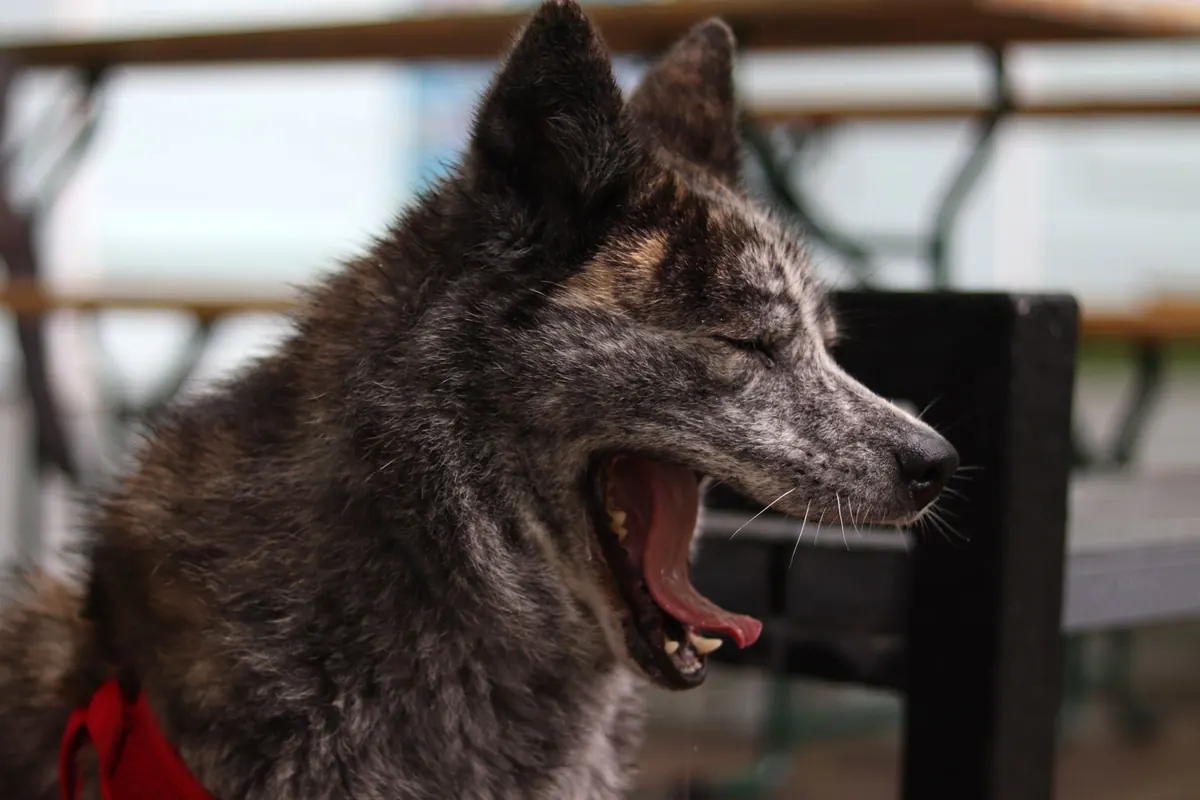
Contagion is the part everyone notices. Reading about yawning, hearing one across a room, or even seeing the word on a page can set one off. It isn't uniquely human, either. Chimpanzees catch yawns from each other, and some studies suggest dogs catch them from their owners, though the dog research is genuinely mixed.
The social explanation is that contagious yawning relates to empathy and social closeness. Children generally don't start catching yawns until around age four or five, roughly when other social-cognitive skills come online. People tend to yawn more in response to a friend or family member than a stranger, and scores on empathy questionnaires correlate with contagion rates in some studies. Treat this as suggestive rather than settled. The correlation exists; how much it explains is still argued about.
Another strand of research frames yawning as an arousal mechanism rather than a cooling one, or as both at once. A yawn nudges heart rate and alertness up slightly, which would be useful at the exact moments yawns tend to appear: waking, drifting off, boredom, and pre-performance nerves. Parachutists have been observed yawning before jumps. So have musicians before walking on stage. Neither group is short on oxygen.
Common triggers, in rough order of how often they show up:
Probably more than one, which is why the debate has lasted this long. Brain cooling best matches the physiology. The arousal and state-change idea best matches the timing. Contagion is a social layer on top of a reflex that already existed. The oxygen theory is the one you can safely discard.
It's also worth remembering that not every behaviour has a tidy purpose. Yawning may be a leftover that got repurposed, or a small housekeeping reflex that does several minor jobs at once. Researchers are still working on it, which is a fair sign that the answer isn't simple.
If you're yawning constantly through the day, the fix is usually boring and effective:
One caveat worth taking seriously: if yawning arrives with unusual drowsiness despite good sleep, dizziness, or breathing trouble, or if it started alongside a new medication, mention it to a doctor. Excessive yawning can accompany some sleep and medical conditions, and that's a conversation for a professional rather than a checklist.
Otherwise, yawn away. It's one of the few reflexes you share with your dog, your neighbour, and the person two rows ahead who just started it up again.

A ton of curious facts and stories.
Copyright © 2026 Curious Ton. All rights reserved. Curious Ton.