
October 10, 2026


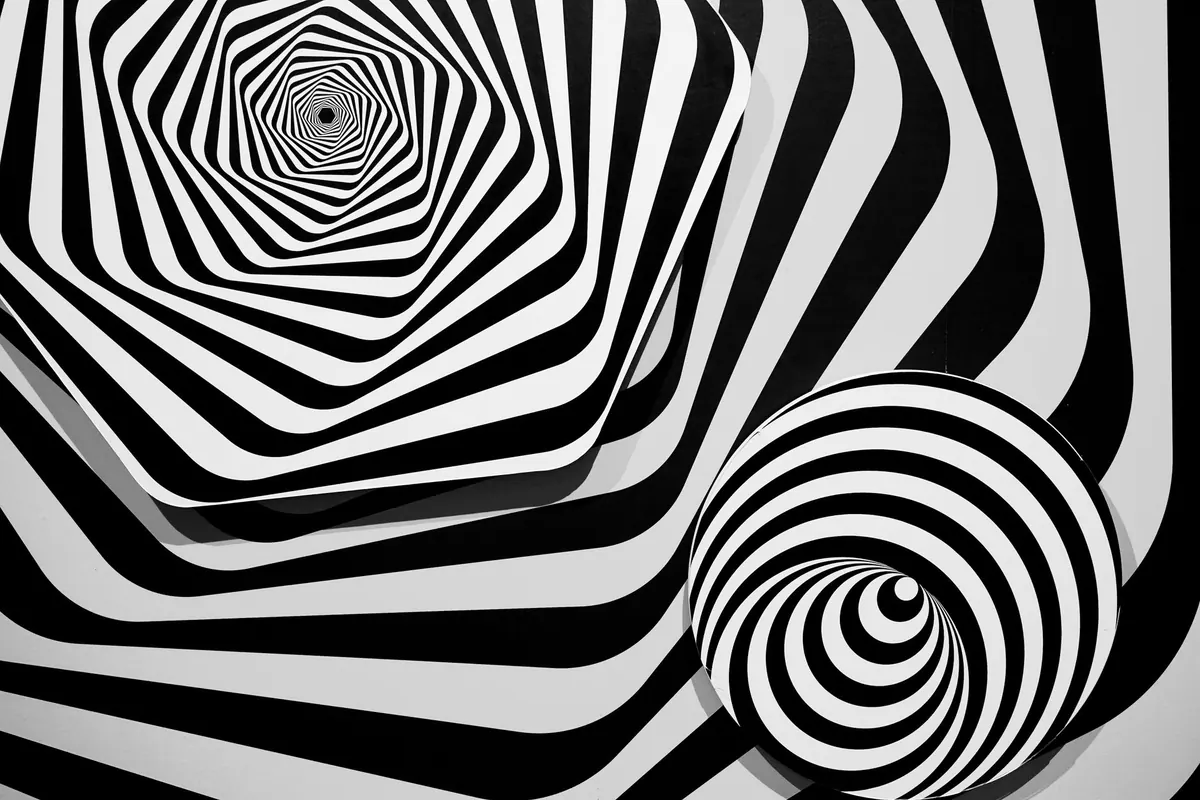

Stare at a bright window for ten seconds, then look at a blank wall. A dark rectangle floats there, shaped exactly like the window frame. Your eyes are not malfunctioning. They are adapting to the light, and the afterimage is the residue of that adaptation.
Optical illusions work in a similar spirit. They are not signs of a broken eye so much as places where the visual system's shortcuts become visible. A few of those shortcuts are worth knowing, because they show up everywhere: in paint colours that look wrong on the wall, in photographs where sizes surprise you, in patterns that seem to move on a printed page.
Only a small patch of your retina — the fovea — resolves fine detail. Everything outside it is blurry, colour-poor and slow, which is why you have to point your gaze directly at a word to read it comfortably. On top of that, your eyes flick several times a second in quick jumps called saccades, smearing the image each time.
From that shaky input, the brain assembles a stable, detailed picture. It fills in the blind spot where the optic nerve leaves the eye. It edits out the shadow of your own nose. It adjusts for the dim amber light of a restaurant so a white napkin still reads as white. Most of this happens before you are aware of anything at all.
Two families of shortcuts matter for illusions:
An illusion appears where a shortcut meets a situation it was never tuned for. The rule still fires; the scene just doesn't match.
Put one identical gray square on a black background and another on a white one. The square on black looks lighter. Nothing about the squares changed. Your visual system judges brightness relative to surroundings rather than in absolute terms, because in the real world — under trees, in doorways, at dusk — relative comparison is far more useful than absolute measurement.
The famous checker shadow illusion takes this further. A dark square sitting inside a shadow is drawn with exactly the same pixel value as a light square outside it, yet they look completely different. Part of the reason is comparison with neighbours, and part is the assumption that a surface in shadow must be brighter than it appears.
Open a photo on your screen, then slide a piece of paper over everything except one small area of colour. Watch how your judgement of that colour shifts once its neighbours are hidden. The colour didn't change; your reference did.
This has practical consequences. When choosing paint, fabric or flooring, compare samples against a neutral surface rather than against the wall you intend to cover, and look at them in both daylight and evening light. When editing a photograph, trust the pixel values your software reports more than your eyes, especially after you have been staring at the image for a while.
Think of railway tracks running to the horizon. Your brain reads that convergence as distance, automatically and permanently. Now place two identical horizontal bars between two converging lines, one near the narrow end and one near the wide end. The upper bar looks longer. This is the Ponzo illusion, and it works because your brain treats the scene as a three-dimensional one and scales the bars accordingly.
The same habit explains other classics. In the Müller-Lyer figure, two equal lines end in arrowheads that either point inward or outward; the outward-pointing version looks longer. In the Ebbinghaus illusion, a circle surrounded by larger circles looks smaller than an identical circle surrounded by smaller ones.
Knowing the trick does not dissolve it. That is the important part. These judgements happen early and automatically, in much the same way that you cannot look at a printed word and choose not to read it. Reasoning arrives afterwards, and it loses.
Some patterns of light and dark edges appear to rotate when you move your eyes across them, even though the page is still. The effect is usually strongest out of the corner of your eye and fades when you stare straight at one spot. A common explanation involves edge-detecting cells responding at slightly different speeds, so small eye movements create a ripple that the brain reads as movement.
The reverse also happens. Steady, unchanging peripheral detail tends to fade from awareness if you hold your gaze still — which is one reason a static, low-contrast pattern can seem to disappear while you look at it.
Motion cues can even override your sense of balance. Sit in a stationary train and watch the train beside you pull away; for a moment you feel your own carriage move. The brain gives visual motion a lot of weight when judging self-motion, and it can briefly outvote your inner ear.
Two dots above a short line will read as a face. That tendency, called pareidolia, is why people see faces in electrical sockets, cloud formations, toasted bread and the front ends of cars. Face perception is a specialised, high-priority job in the brain, and it is tuned to err toward false alarms: mistaking a stranger for a friend is cheap, while missing a face can be costly.
The same bias explains why a coat on a chair becomes a figure in a dark room, and why designers give products headlight-like "eyes" to make them feel friendly or aggressive. Once you notice the pattern, you see it everywhere — which is the point.
Web and print designers lean on contrast to guide attention, and on alignment to create a sense of order, because the eye follows those cues before the mind has a chance to argue. Photographers use converging lines to suggest depth, and place a familiar object — a hand, a coin, a doorway — in a wide-angle shot so viewers can judge scale correctly rather than guessing.
Some roads use painted lines that crowd closer together or narrow slightly, which makes drivers feel they are moving faster than they are and encourages them to ease off the accelerator. High-visibility clothing works not only by being bright, but by creating strong contrast against expected backgrounds.
A good magician does not hide the move so much as give your attention somewhere better to sit. Sudden motion, sharp contrast and a confident gesture pull the eye away from the hand that matters. The trick depends on your prediction machine doing exactly what it always does.
Reading about illusions is fine. Running a few yourself is better. Set a screen or a printed page at a comfortable distance, keep the light even, and stop if your eyes feel strained.
What you are really testing is not your eyesight. It is the speed of the machinery underneath it, which guesses first and asks questions later. That is a good design for a brain navigating a busy world, and a mildly humbling one for anyone who trusts their eyes as impartial instruments.
One sensible note: if you notice new or persistent visual distortions — straight lines bending, wavy edges, sudden flashes, a shower of new floaters, or a patch of vision that vanishes — see an optometrist or doctor promptly rather than testing yourself with puzzles. Those symptoms can have treatable causes, and self-diagnosis is the wrong tool for them.
Photo: Magda Ehlers / Pexels

A ton of curious facts and stories.
Copyright © 2026 Curious Ton. All rights reserved. Curious Ton.