October 10, 2026



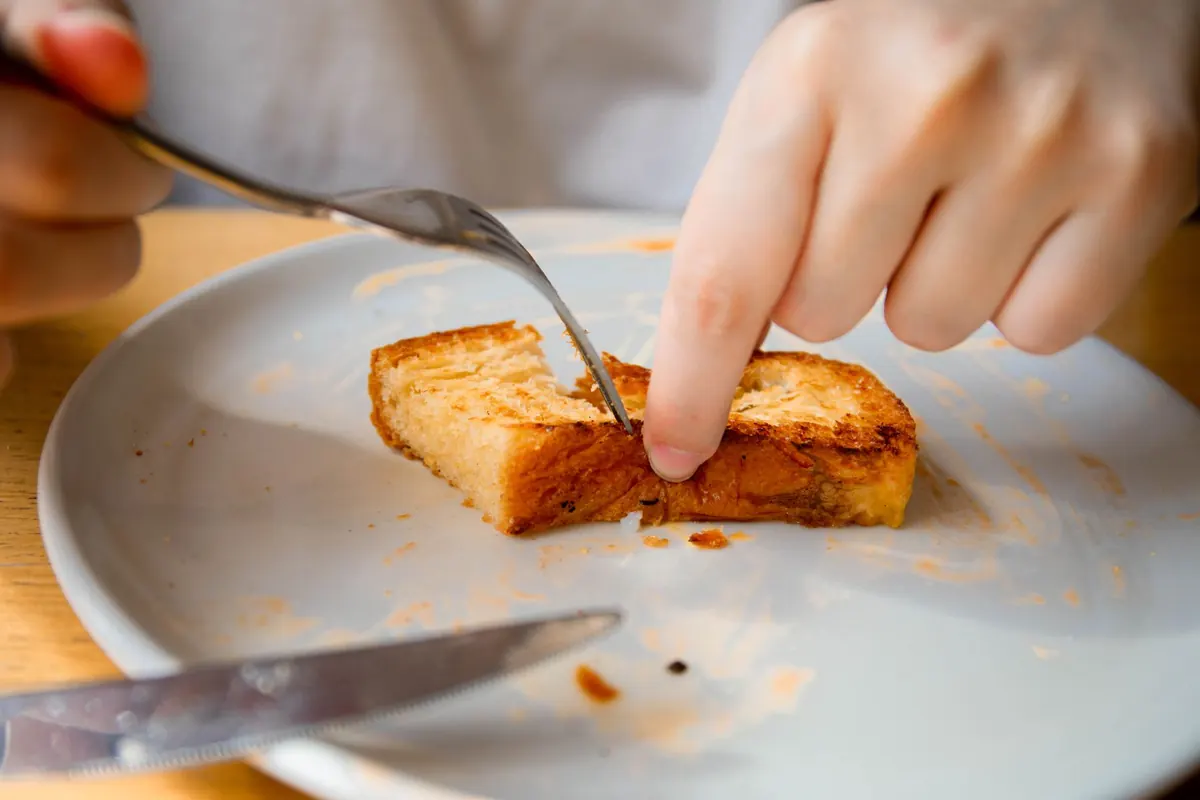
You know the sequence. Plate in one hand, knife in the other, a warm slice balanced somewhere in between. Then a small slip — the toast slides off the edge, turns over once in the air, and lands face-down on the kitchen tile. Butter, jam, and a thin film of regret.
It happens often enough that most people assume the universe has a position on breakfast. It doesn't. What it has is physics, plus a memory that keeps score unfairly. Separate those two things and the buttered toast problem stops looking like bad luck and starts looking like a predictable, largely avoidable flaw in the way we handle food.
In fact, the phenomenon is so common that it has a name: the buttered toast phenomenon, or sometimes the "buttered cat paradox" when mixed with the old joke about cats always landing on their feet. But strip away the folklore and you're left with a tidy problem in rotational mechanics, one you can understand with a plate, a slice of bread, and a stopwatch.
Toast almost never drops straight down. It leaves from a plate or a hand resting on a surface, and it goes over the edge. When a flat slice slides past the lip, that lip — the rim of the plate, the table edge, your thumb — becomes a pivot. The slice keeps moving forward while gravity pulls its centre of mass downward, and that combination turns a slide into a rotation.
Think of a diver leaving a springboard. The board's edge provides the pivot; the diver's forward momentum and the pull of gravity create the somersault. Toast does the same thing on a much smaller scale. The slice doesn't just fall; it pivots over the edge like a tiny, tragic trampoline act.
This is the part most people miss: the toast doesn't start spinning in midair. It is already turning when it leaves. A slice nudged off the rim of a plate picks up a lazy half-turn's worth of spin. One knocked off with a quick elbow picks up more. Whatever the slice has at the moment of release is roughly what it keeps, minus a little air resistance.
Now add the height. From a standard kitchen table, about 75 centimetres, a dropped object hits the floor in a bit under half a second. Shove a book off the edge and listen — the bang arrives almost exactly when your hand expects it, which is why the sound feels so abrupt.
In that fraction of a second, a slice of bread turning at roughly one revolution per second will rotate about half a turn. And your toast starts butter-side up, because that's how it sits on the plate and how you hold it. Half a turn is precisely the amount needed to put the buttered face on the floor.
If you want to test this, try dropping a piece of dry toast from table height while filming it in slow motion. You'll see the rotation begin at the edge, and the slice will usually complete between 120 and 180 degrees of turn before impact. That's the sweet spot for a butter-side-down landing.
Here is where the phenomenon earns its reputation for malice. Our tables sit at the height that happens to pair with the average spin of a falling slice to produce a landing that is both face-down and messy. Raise the table to about three metres — four times the height, which doubles the fall time — and the toast would complete a full turn and land butter-side up. Lower the drop to a coffee table and the slice often runs out of time mid-tumble and lands on its edge or its back, and you pick it up with a shrug.
Nothing about this is cursed. It's a coincidence of furniture design, the strength of gravity, and the size of a slice of bread. If we ate breakfast standing at chest-high counters, the toast might land clean more often. If we ate lying down, the whole question would be moot.
The instinct is to lunge. The lunge rarely works. By the time you've seen the slice slip, your brain has to register the event, decide on a response, and send the signal down your arm. Simple reaction time in a healthy adult runs around a fifth of a second — already half the total fall, and that's before your hand goes anywhere.
Then there's geometry. Your hand isn't under the toast, and the toast isn't falling straight down. It's tumbling sideways off an edge, spinning, often clipping the plate on the way. Even a successful swat usually just changes the rotation and sends the slice further across the room. Watching someone try to catch falling toast is watching someone make the mess bigger.
There's also the matter of the butter itself. Warm butter or jam lowers the friction between the toast and your fingers, so even if you do make contact, the slice can squirt out of your grip like a wet bar of soap. The attempt becomes a juggling act, and gravity wins those every time.
A butter-side-down landing is loud, visible, and expensive in cleaning time. A butter-side-up landing is quiet, undramatic, and costs you nothing. Guess which one you remember.
Drop toast ten times and some of those landings will be clean. You'll pick the slice up, dust it off, and forget it before you've finished chewing. The other landings leave a smear, and you'll remember every one of them for years. The tally in your head isn't a tally of reality; it's a tally of incidents.
Plenty of things decide what you notice, and a floor-facing smear of butter is loud. A clean landing is invisible. So the next time you drop a piece of toast and it lands butter-side down, take a breath. You are not the victim of a cosmic joke. You are the victim of a table edge, a half-second fall, and a brain that keeps a grudge.
Yes, mostly. The physics is predictable, which means the outcome is partly under your control. Here are a few practical tricks that actually work:
None of these are guaranteed. Physics doesn't offer guarantees, only probabilities. But they shift the odds in your favour, and that's often the best you can do.
Photo: Sergey Meshkov / Pexels

A ton of curious facts and stories.
Copyright © 2026 Curious Ton. All rights reserved. Curious Ton.